I always get a bit excited when a book I’m waiting for finally releases, so it’s great to finally share that The Conflict Thesaurus: A Writer’s Guide to Obstacles, Adversaries, and Inner Struggle (Vol. 2) is now out!
This SILVER EDITION is the twin of the GOLD EDITION and continues to explore all the ways we can better leverage the conflict in our story.
If you are new to these “thesaurus” books, each one is part writing guide, part brainstorming tool.
The first part of this book dives into how conflict powers your plot and is the golden thread that weaves your inner and outer stories together. It also digs into how to craft great villain clashes, character agency, how to maximize tension, what goes into a satisfying story climax, and more.
The second part of the guide is a mother lode of conflict scenarios (115 to be exact) built to get your imagination thrumming with ideas. You must see it to believe it.
I’m part of Angela & Becca’s Street Team, and I have news:
Writers Helping Writers is hosting a Writing Contest!
A book about conflict needs a FIGHT CLUB Story Contest, right? Exactly! So if you want to show Angela & Becca how good your conflict-writing skills are, check out this contest and see what you can win.
GIVEAWAY ALERT!
Angela and Becca are also hosting a must-enter giveaway. They’ve filled a vault full of their favorite writing books and are giving away some digital 5-packs, winner’s choice!
So much fun. Make sure to head over and enter, and good luck!
This guide is about that killer ingredient our stories need: Conflict. It shows you exactly how to use conflict to raise tension, create a fresh story premise, and pull readers in. The guide also dives into over 100 conflict scenarios and how each can be endlessly adapted to challenge a character inside and out. Problems, Moral Dilemmas, Ticking Clocks, Obstacles, No-Win Scenarios…this book is plot brainstorming in overdrive!
I’m part of Angela & Becca’s Street Team for this release, and we have an important question to ask you:
Can You Survive Danger as Well as Your Favorite Protagonist?
Sure, it’s easy for you to use conflict to torture your characters and make them struggle, but what if it’s you in the hot seat instead? Will you make good decisions, or bad ones?
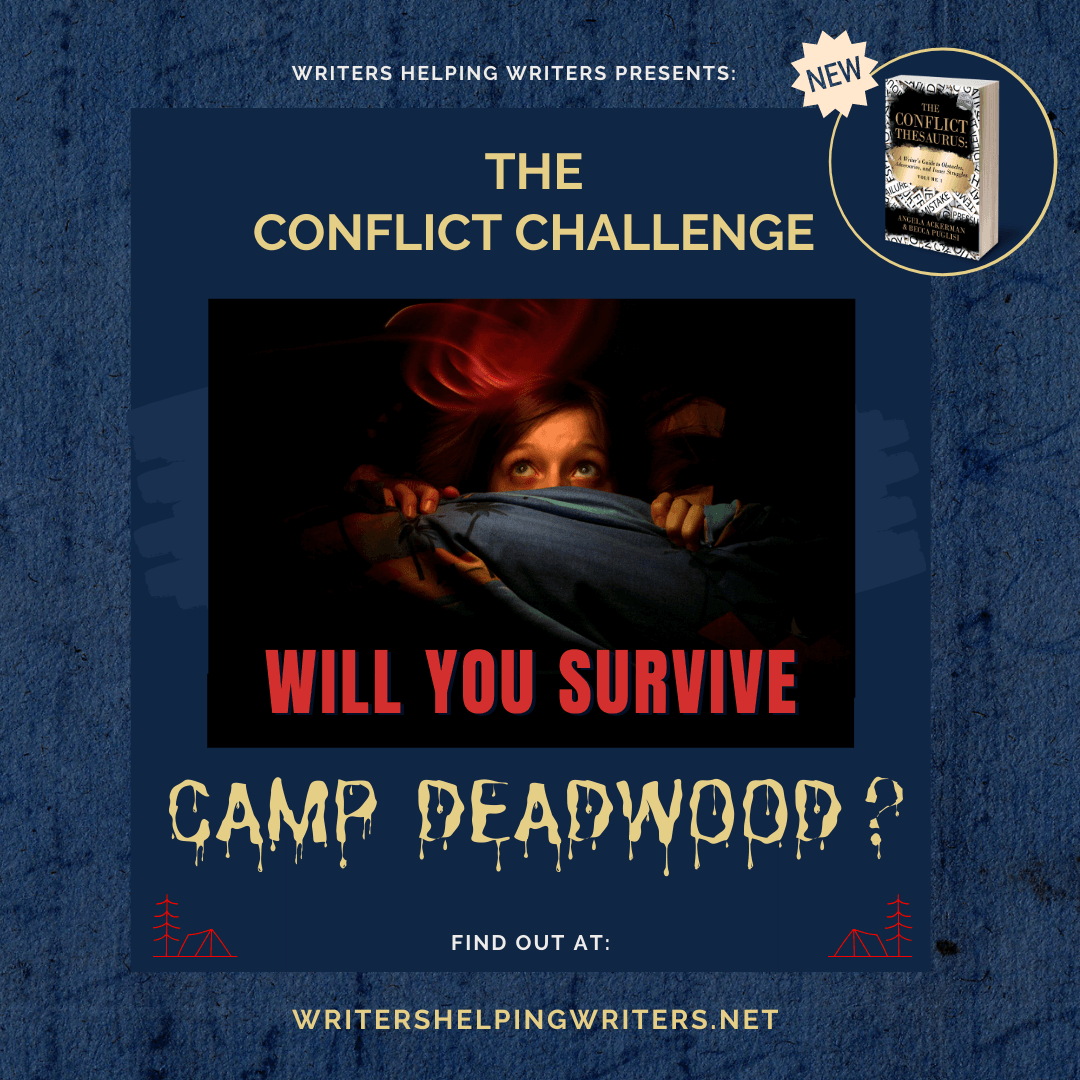
It’s time to find out by taking the Conflict Challenge! I dare you to become the protagonist in a special story Angela & Becca have created. And heads up, if you survive, you win some pretty cool stuff!
GIVEAWAY ALERT!
While you’re at Writers Helping Writers taking the Conflict Challenge, make sure to enter The Conflict Thesaurus celebratory giveaway, too. But hurry – it’s only on for a few days.
If you’d like to find out more about how The Conflict Thesaurus can help your character construction and story, these spectacular writers have put together some posts about conflict and its importance. Check them out with these links:
You can find links to purchase The Conflict Thesaurus and any of the other Writers Helping Writers thesauruses here: https://writershelpingwriters.net/bookstore/ . Get yours TODAY! Your characters will thank you!
Hard on the heels of finishing Sacha Black’s newest masterpiece 8 Steps To Side Characters, this article, “The Walking Stick” , appeared in my inbox. Sacha’s book left my mind reeling, digesting much of what I knew stated in a different way that added clarification and inspiration. Then I read Mr. Maass’s no-punches-pulled airing on the idea of ‘authentic’ characters and what authenticity really means.
Yep, mind-blown. 🤯
To keep your characters from falling flat, starting flat, or feeling flat, I highly recommend these two resources. Happy writing!~
Solid side character instruction with a slathering of singularly-Sacha humor. I recommend it highly!
There’s a concept in storytelling that I’ve long tried to understand: “authentic”. Mostly it’s invoked with respect to characters. It’s important to know them. It’s important that they act and speak in ways consistent with who they are, whether entering a room or rocketing to the stars. It’s also important to know how they came to be who they are. Back story wounds and burdens shape and define them and become the engines of change.
If writing is “authentic” then every gesture, action and utterance is “honest” and everything observed is rendered in a way both original and pinpoint accurate. “Authentic” means writing not to formula but as characters would actually behave, whatever the circumstances. “Authentic” means they go about their business in their own ways, not the author’s. Even when they are inspired by real people or reflect the author’s own experience, if characters are “authentic” then a story will always have internal logic and integrity.
It’s something like that.
What bothers me is, how does knowing characters and honoring their independent existence help you to write a story? I mean, it’s nice if characters behave in ways that are lifelike—or which at least conforms to our understandings of them—then, so far, they can only display who they are. A backstory-induced need is a good thing and can propel a character toward some sort of emotional resolution, but by doing what? On top of that, when characters are strongly defined and consistent how can they surprise us? read more…
This topic caught my eye while I was scrolling. I enjoyed the discussion about the phases a manuscript goes through as it passes to different people on the publishing journey. We all believe our writing to be a part of us, but isn’t the idea that it becomes “real” only once someone else has read it a bit ironic? The section about the author-editor relationship and how an editor views a book is informative—something to be kept in mind when you send your work out. Well worth reading for writers and editors, enjoy!~
Carolyn Haley Writing a novel has often been likened to having a baby. The analogy is apt, in terms of gestation, obsession, pain, thrill, frustration, and all that goes with the long-term development of a new life. Less often discussed is what happens later in the process, when it’s time to push the fledgling out […]
One of the editing tips I recently posted on my social media channels for Red Leaf Words Services had to do with rephrasing clichés in your own unique way when you want to use the basic idea. This post from the informative ladies at Writers Helping Writers shows you how to do just that. Your readers will thank you!~
One of the things that pumps me up the most when I’m reading a book is when the author phrases things in a way I’ve never seen before. It could be a familiar concept or image—red hair, an urban street, fear—but when it’s written differently, I’m able to visualize that thing in a new way,…
The first Wednesday of every month is officially Insecure Writer’s Support Group day. Post your thoughts on your own blog. Talk about your doubts and the fears you have conquered. Discuss your struggles and triumphs. Offer a word of encouragement for others who are struggling. Visit others in the group and connect with your fellow writer – aim for a dozen new people each time – and return comments. This group is all about connecting!
Let’s rock the neurotic writing world! Our Twitter handle is @TheIWSG and hashtag is #IWSG.
March 3 question – Everyone has a favorite genre or genres to write. But what about your reading preferences? Do you read widely or only within the genre(s) you create stories for? What motivates your reading choice?
Up until a few years ago my reading preference was single-minded: Fantasy.
I hadn’t even thought seriously about writing a book, so that wasn’t part of the equation. When I went to find reading material, I went straight to the fantasy section and that was it.
Then came the day that I was browsing in my local library and I saw Deborah Harkness’s A Discovery of Witches. The cover drew my attention, the blurb reeled me in and I took it with me. A crack appeared in my fantasy-hardened reading focus.
Now with all of the publicity surrounding the tv show based upon that book, you probably know something about it. Maybe only that there is magic in it, so there is a fantastical element present—I didn’t really stray that far.
But that was just the beginning. I blew through the All Souls series, fell completely in love with it, and had the worst book hangover ever after I was done.
I wanted more. I wanted more alternate history stories. I wanted to see where authors’ imaginations take them when historical events are the prompts.
That was the beginning of my obsession with historical fiction set in Europe.
If I look at it critically, it really shouldn’t have surprised me as it did. I have always gravitated toward European history prior to 1900, those are the elective classes I took and what I enjoyed learning about at any point in school. I even took history classes when I studied in Ireland for a year.
Even this time period restriction has eased, though. My current audiobook binges are all set in England and Europe around both World Wars.
Next came my offer to read a novel as a beta reader for a friend in a Facebook group.
Wow, is that a fun genre! I binged that for months, filling my Kindle with its brassy, mechanical tales swathed in multi-layered skirts, clockworks, and evening suits. It has become my go-to for a fun, adventurous, mechanically magical page-turner.
With fantasy being my first and steadfast love, that is what I want to write first. I’m well on my way to doing that, publishing a blog series with the worldbuilding for my created world while I work on sorting through the elements of the main story that stumbles around in my brain.
But every so often, the idea of delving into a historical fiction story or a some-kind-of-punk mystery raises its hand and my writer-brain wants to take a ditch-dive into the ‘shiny new thing.’ One day, yes, I will do it. But first things first.
I also honor my true love of books and bookstores, gravitating toward titles about libraries, bookshops, scrolls, and the like, which has led me to some contemporary fiction. Then there’s paranormal (give me a vampire any day, go ahead, bite me, please!) and the many, many YA and NA (new adult) books I’ve enjoyed.
I guess I do ready sort of widely. Somewhat. I’ve tried murder mysteries, thrillers, cozy mysteries, and women’s fiction, too. It’s all been fun.
Since I’ve branched out, I’ve realized that I do have moments when I want something specific, a certain tone or type of story, and I can usually find it in my TBR list (which is endless).
Covers do draw me in, as a first contact point, or repel me. In fact, I find that the current trend of putting close-up images of people on the covers does nothing for me. It’s fine if there is a character depicted, but what else is there? Symbols, landscapes, buildings, books, what else is there to draw my attention and make me pick up the book to read the blurb? That’s what piques my curiosity and what I want to see in my mind when I read.
I know expanding my reading genres has expanded my ability as a writer and storycrafter. It has to. It’s part of the alchemy that happens in the brain when it is exposed to story. It takes all the bits of inspiration and craft and scrambles it up together to put out my unique author voice.
We are all influenced by what we read. It is important to acknowledge and accept that, even embrace it because that’s how writers learn and develop. Nonfiction that teaches writing craft is excellent, but reading identifies all of those principles in action and helps to inspire our minds to weave them into our own tales.
So yes, read. Read your own genre profusely. But try not to ignore others. You never know which phrase from a horror thriller will be the spark for the reaction that creates your plot twist.
Reading expands our minds and imaginations, fills the creative well. Reading creates inspired writers.~
If you are curious about my fantasy writing, please check out my Collection of Huphaea blog series here on this site!
Time and pacing are always foremost thoughts in an author’s mind when they are plotting or writing.
Is it too slow?
Is it too fast?
What if I slow it down a bit, will people lose interest?
And then there comes the moment when the plot puzzle seems to not work together timewise. What do you do then?
This Writer Unboxed post offers some insight into how to deal with this conundrum. Happy reading!~
We’ve all had the experience of something being over in a flash and, in contrast, of time feeling endless. Time feels different, depending on where we are and what we want. It’s the same for our characters—and our readers. As writers, we juggle several kinds of time. I hadn’t really thought about this—not explicitly—until I…
I couldn’t resist reblogging this article by my favorite writing craft author, Lisa Cron. Though it is a few years old now, the principles discussed are still relevant and foundational for writers of all levels. I hope you enjoy it.~
photo by R/DV/RS via Flickr Let’s talk about backstory. Last month in my post I wrote a lot about it, and when reading through the always insightful comments, it struck me that there is a bit of legitimate confusion, along with some deeply ingrained misconceptions, about backstory: what it is, its role when creating a […]
Writing fiction has its advantages—you get to make stuff up. But what happens when you draw on what you know (as we all do) and then EVERYTHING changes mid-draft? Did your writing change from pre-pandemic to post-pandemic and how do you handle that? I found this a very thought-provoking article that touched on some of the wrinkles many authors may dance around.~
Carolyn Haley Thanks to our collective and often-divisive experiences over the past year, I’ll wager we all agree that 2020 was one heckuva rough ride with long-term consequences yet to be known. The events have introduced new concerns specific to fiction writers, editors, agents, and publishers. For instance, should authors of contemporary fiction include the […]
I see this topic come up in conversation in online writing groups constantly. This Writer Unboxed episode provides a solid idea of what to expect from an editor and why we aren’t to be feared. Editors have a genuine desire to help authors improve their craft and see their creativity shine. Many of us are writers too, we understand the discomfort involved, and trust me, we don’t want to perpetuate it in someone else! ~
Letting other people—even those close to you—read your novel for the first time can be stressful. You’ll wonder if they’re going to judge you, if they’ll recognize themselves in there, or if you really want your mother to know that you know about these things. But after the first few times, you get used to…
One difference I would note is that where Mr. Dempsey talks about the notations and comments made in “…copy editing and proof reading” stages, at Quill & Orb Press those notations would be part of my line editing and copy editing services.
If you would like to learn more about Quill & Orb Press editing, please visit me here. Enjoy your day!~


 The Sun, a Book, and a Dog