Nyssa’s Nuggets

“I can still do what I love.”

The other night I was heading to bed and went to say ‘good night’ to the dogs. I couldn’t find Nyssa.

Yeah, I know. How could I not find an Akita? Had I left her outside? I was sure I hadn’t, I had just let them all in and given them their nightly liver treats.

I ran around looking for her, turning on lights I had already turned off, when the curtains behind the couch moved. Then she stepped out of the picture window and back over onto the couch where she sleeps.

Ah, yes. I forgot about that.

I constructed my picture window to be deep enough and strong enough for me to sit in and read. Complete with a slate tile sill so spilled plant water wouldn’t be an issue.

But it has become a favorite dog-napping spot instead. For Nyssa especially. I think she stays awake watching out the window for wildlife most of the night.

It is also a way for her to do what she loves—hunting. Just in a different manner.

I often hear that editors find it difficult to read for pleasure. I feel quite sad about that.

Reading is my escape, I have always loved it. It has made me want to write and to be an editor.

I can understand how the mechanics of editing could get in the way of reading. I have noticed my awareness of craft principles has ratcheted up manyfold, but it hasn’t diminished my ability to enjoy the story or my desire to read for fun. In fact, in many ways, it has enhanced it.

As important as it is for writers to read in their genre (and out of it), it’s the same for editors. Genre conventions, tropes, subject matter, reader expectations, all of these are constantly changing and the only way to keep on top of them is to stay familiar with what is rising and falling in interest.

Which means we have to read.

Yes, we read all day while we edit. Reading for our own enjoyment is another way to fill the editor’s toolbox, though. Much as writers absorb pieces of what they read and it all gets scrambled up to make their own author voice, the same happens with editors.

One author’s clever use of time could stick in your mind and then provide a new angle for a suggestion you make to another author several months later. Description techniques, first line hooks, chapter endings, the list of things you can pick up for use later on is endless.

Editing is a way to better reading, and reading is a way to better editing. As long as our eyes (and ears) hold out, there is plenty to be gained from pleasure reading. Let it enhance your editing skills. I have no doubt Nyssa’s nighttime window hunting improves her field hunting. She never misses a movement in a stone wall or in the tall grass.

Then maybe the next time you are searching for the right suggestion to take an author’s work that extra bit further, it will be relaxing in the back of your mind, waiting to be called upon. Pull it out of your picture window and let it work for you.

Have a great week! Woof woof roooooo! 🐕‍🦺~


Do you find it difficult to read for fun if you are an editor, or in editing mode? What exactly gets in the way? Let me know in the comments, I’m interested to hear your thoughts. 👇🏼

If you’d like to get more editing tips for your own editing endeavors, subscribe to the Red Leaf Word Services newsletter and get your copy of my 15 Tips for Self-Editing checklist.

You can find the checklist popup at www.redleafwords.com, or use this link here to sign up and get your copy! You may even get more of Nyssa in the newsletter too 😉.

©2021 Red Leaf Word Services. All Rights Reserved.

Insecure Writers Support Group March Post

The first Wednesday of every month is officially Insecure Writer’s Support Group day. Post your thoughts on your own blog. Talk about your doubts and the fears you have conquered. Discuss your struggles and triumphs. Offer a word of encouragement for others who are struggling. Visit others in the group and connect with your fellow writer – aim for a dozen new people each time – and return comments. This group is all about connecting!

Let’s rock the neurotic writing world!
Our Twitter handle is @TheIWSG and hashtag is #IWSG.

March 3 question – Everyone has a favorite genre or genres to write. But what about your reading preferences? Do you read widely or only within the genre(s) you create stories for? What motivates your reading choice?


Up until a few years ago my reading preference was single-minded: Fantasy.

*Image by Stefan Keller from Pixabay

I hadn’t even thought seriously about writing a book, so that wasn’t part of the equation. When I went to find reading material, I went straight to the fantasy section and that was it.

Then came the day that I was browsing in my local library and I saw Deborah Harkness’s A Discovery of Witches. The cover drew my attention, the blurb reeled me in and I took it with me. A crack appeared in my fantasy-hardened reading focus.

Now with all of the publicity surrounding the tv show based upon that book, you probably know something about it. Maybe only that there is magic in it, so there is a fantastical element present—I didn’t really stray that far.

But that was just the beginning. I blew through the All Souls series, fell completely in love with it, and had the worst book hangover ever after I was done.

Image by DarkmoonArt_de from Pixabay

I wanted more. I wanted more alternate history stories. I wanted to see where authors’ imaginations take them when historical events are the prompts.

That was the beginning of my obsession with historical fiction set in Europe.

If I look at it critically, it really shouldn’t have surprised me as it did. I have always gravitated toward European history prior to 1900, those are the elective classes I took and what I enjoyed learning about at any point in school. I even took history classes when I studied in Ireland for a year.

Even this time period restriction has eased, though. My current audiobook binges are all set in England and Europe around both World Wars.

Next came my offer to read a novel as a beta reader for a friend in a Facebook group.

Splash. I fell into steampunk.

Image by DarkmoonArt_de from Pixabay 

Wow, is that a fun genre! I binged that for months, filling my Kindle with its brassy, mechanical tales swathed in multi-layered skirts, clockworks, and evening suits. It has become my go-to for a fun, adventurous, mechanically magical page-turner.

With fantasy being my first and steadfast love, that is what I want to write first. I’m well on my way to doing that, publishing a blog series with the worldbuilding for my created world while I work on sorting through the elements of the main story that stumbles around in my brain.

But every so often, the idea of delving into a historical fiction story or a some-kind-of-punk mystery raises its hand and my writer-brain wants to take a ditch-dive into the ‘shiny new thing.’ One day, yes, I will do it. But first things first.

I also honor my true love of books and bookstores, gravitating toward titles about libraries, bookshops, scrolls, and the like, which has led me to some contemporary fiction. Then there’s paranormal (give me a vampire any day, go ahead, bite me, please!) and the many, many YA and NA (new adult) books I’ve enjoyed.

I guess I do ready sort of widely. Somewhat. I’ve tried murder mysteries, thrillers, cozy mysteries, and women’s fiction, too. It’s all been fun.

Since I’ve branched out, I’ve realized that I do have moments when I want something specific, a certain tone or type of story, and I can usually find it in my TBR list (which is endless).

Covers do draw me in, as a first contact point, or repel me. In fact, I find that the current trend of putting close-up images of people on the covers does nothing for me. It’s fine if there is a character depicted, but what else is there? Symbols, landscapes, buildings, books, what else is there to draw my attention and make me pick up the book to read the blurb? That’s what piques my curiosity and what I want to see in my mind when I read.

I know expanding my reading genres has expanded my ability as a writer and storycrafter. It has to. It’s part of the alchemy that happens in the brain when it is exposed to story. It takes all the bits of inspiration and craft and scrambles it up together to put out my unique author voice.

Image by loulou Nash from Pixabay

We are all influenced by what we read. It is important to acknowledge and accept that, even embrace it because that’s how writers learn and develop. Nonfiction that teaches writing craft is excellent, but reading identifies all of those principles in action and helps to inspire our minds to weave them into our own tales.

So yes, read. Read your own genre profusely. But try not to ignore others. You never know which phrase from a horror thriller will be the spark for the reaction that creates your plot twist.

Reading expands our minds and imaginations, fills the creative well. Reading creates inspired writers.~


If you are curious about my fantasy writing, please check out my Collection of Huphaea blog series here on this site!

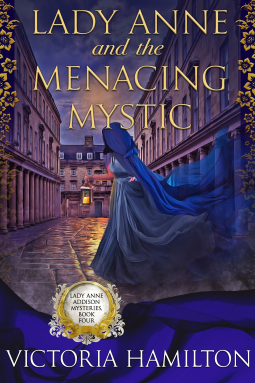
Book Review: Lady Anne and the Menacing Mystic

by Victoria Hamilton

*I received access to this title in exchange for an honest review, which I am happy to leave.*

Much of the historical fiction I have recently read takes place in London, so when I saw Lady Anne and the Menacing Mystic is set in the famous and beautiful city of Bath, I was eager to read it. The asserted healing properties of the water, and the resurgence of its popularity in the nineteenth century made for an elegant and engaging backdrop to the mystery. Through the daily routines of the citizens “dependent” upon the water’s curative effects, we are transported into the hierarchy of Bath society with Lady Anne as she visits with her mother in preparation for the announcement of her own engagement.

I had not read any of the previous Lady Anne novels that Victoria Hamilton has written, but that did not restrict my understanding or empathy for Lady Anne or the other characters. The novel can be read as a stand-alone easily, though it may suggest that reading the prequels would be worth it for the story behind Anne and Lord Darkefell’s romance. The portrayal of the lord as dark, haughty, and sympathetic to women of his time who would control some of their independence is skillfully woven into the story as Anne conducts her own rebellions within the close Bath society.

Themes of love, secrets, truthfulness with oneself, exploitation, and societal beliefs are all explored through Anne’s discovery and solving of a murder mystery that involves those close to her. We learn of the complex relationships society demands women maintain, and the depravity they suffer when they do not. Anne treads a fine line between impropriety and inclusion in her goal of maintaining independence and marrying a marquess, to the marvel of her mother and Bath society. It is her tenacity, however, that leads her to pursue an investigation into an untimely death in an effort to spare her friends shame. What she discovers to be at the heart of the deception shakes her definitions of truth and appearance.

Lady Anne and the Menacing Mystic is an enjoyable delve into Georgian society outside London, with all of the decorum and formality of the era. Historical fiction fans will appreciate the complexity and physical description of the city of Bath and its contribution to the story. I recommend it to historical fiction mystery fans who would enjoy a trip outside of London. Partake of the mineral waters of Bath to ease your ailments and enjoy your time sleuthing with Lady Anne!

Books on My Desk

Good Monday morning All! I can honestly say that it is a good Monday morning so far — looking out my office window into bright sunshine on new snow, I am happy to be sitting at my desk enjoying 15°F on this side of the wall. I still have to walk the dogs, but they are happier if it is closer to 20° too.

This past week proved to be productive in the reading department, so I thought I would share a couple of craft books that ensnared me.

Three of the many in my TBR or already read piles…

The first one I read was Verbalize, and if you notice all the mini Post-Its sticking out of it, you can conclude that I found it helpful. IMMENSELY helpful! I had heard interviews with author Damon Suede on several podcasts and everything he said about writing from verbs made complete sense, so I had to check it out. I have been in the process of outlining my fantasy novel for a bit now, but it never felt quite right. I just kept thinking that I wasn’t ready for that step yet, that I was still missing something as related to characters and events. So when I started reading Verbalize, I realized, YEAH I sure am missing something — the reasons why my characters are taking this journey and the actions that motivate them. Don’t get me wrong, I had some idea, but nothing I could sustain for very long when trying to plot. After a reading the book and then completing a few of the exercises, I now feel much better about what actually moves and shakes these individuals.

The other two books in the photo were both highly recommended in Verbalize, so I decided to borrow them from my library system first (yes, I am one of those people who still LOVES to use my library), to see if I should/needed to/wanted to purchase them for permanent reference. I’m over halfway through Wired for Story, and I can say that yes, I do believe I will be purchasing it; it is most worthy of mini Post-its and highlighter treatment. Lisa Cron’s book uses many of the same principles as Suede’s, but approaches it from a ‘how-the-brain-works’ perspective. So far it has been entertaining reading, and very instructive in defining the theme characters take action on, whether they know it or not.

I haven’t actually gotten to Vex, Hex, Smash, Smooch yet, but if it is anywhere in the same vein as the other two, it will also be a solid read. I will post an update as I get into this book, which should be soon (cause it isn’t mine either… yet). Praise to the renewable library loan!

If you hadn’t surmised as such, I am a consummate planner when it comes to writing, and that goes back to the first research paper I wrote in sixth grade — I can still see all my note cards and how they corresponded to my outline, with each piece of information, so that all I had to do was connect them all together with the right words and it was done. That lack of confidence I had every time I sat down to outline was what spurred me to to delve into what I was missing. After a book and a half, I already have a much better handle on the foundation elements of my story. How to work with and refine them to draw the tale, length by length, from the tangled ball of yarn that it is in my imagination. I am so very glad that I read (am reading) these books before lots of words hit the page, but honestly, being a planner, the words wouldn’t have come anyway. Cause now I know there was nowhere for them to come from. HA ha!! <evil villain laugh, with finger in the air> Now the outline begins! ~

What craft books have you read that helped you as a writer? Any that changed your whole outlook or approach? Leave a comment below on writing books that you love to recommend. Til next time, happy writing!~

PS. If you haven’t heard about it yet, there is an extension for Google’s Chrome web browser that checks your local library system for a book whenever you query one online. It’s an EXCELLENT tool, I highly recommend it! Then if you like a book, you can always support the author and buy it for yourself. Win-win!

The Power in a Name


When I pick up a book to read the inner jacket or back cover hook, or if I’m scanning Amazon, Goodreads, Book Sirens, Book Barbarians, any of the myriad places I get my reading material, one of the first things I notice is the name of the protagonist.

What IS in a name?

If I like that particular combination of letters, it ticks a mental box and I am more likely to read on. It doesn’t mean if I don’t like what I see that I won’t investigate further, but I am more likely to continue if I do.

Is that a shallow initial evaluation? Perhaps, but to me it is not. Names have always been a very important and fascinating topic I have explored. It may be some carryover from having a longer, complicated Polish birth surname that was challenging for a four-year-old to learn how to spell. And then add in that my not-unusual first name has an unusual spelling, I have been correcting people from day one. Ugh, <eye rolls>. So maybe then it is all my parents’ fault, but I’m honestly not looking to place blame for something I find fascinating.

My three dogs ( l-r) Dash, Nyssa, and Tristan

So much so, that after I chose Dash for my most recent Aussie boy, and he absorbed the energy of the word 100%, I have kept Zen in the forefront of my mind for the next one… one can hope, right?

Once I was aware enough to make the connection between our mother cows and calves, I made myself responsible for remembering who-went-with-who and their names. Names were chosen for any number of reasons, but never just arbitrarily. There was always a meaning, time period, or reference that inspired the choice. We even had twins born one winter on the day of the Super Bowl that gave us Raider and Redskin. My dogs are no different, it is a part of welcoming a new family member that I take very seriously.

I could fill this room with names…

It should come as no surprise then if I say that one of the reasons I want to write a fantasy novel is that I want to NAME characters, countries, cities, castles, forests, lakes—all of it! And through the naming, each person, creature, and location becomes real to me; in my mind and on paper (or screen) they now have an existence and can be interacted with. One of the most fulfilling blocks of time I spent two weeks ago was naming all 54 of the cities/towns and their House Seats of the family scion that resides there.

Yeah, I said that—54 scion residences and 54 cities or towns. 108 names, and I loved every single minute of it over the three days it took me. Is that excessive? Possibly, but its part of my world building and though I don’t know when I will write any of them in, they are in existence waiting to be deployed. These locations give some structure to my world; physical destinations I can make things happen in, talk about in dialogue, and use as landmarks.

The power in a name, I believe, comes from the interaction of the energy of the word with our own energy. At our most fundamental state, we are beings of energy, and energy flows in waves like sound, or light, or as depicted by the ripples in this pond. A word is a series of sounds (energy waves) made by our vocal cords. The waves interact with those comprising ourselves each time they are spoken (and perhaps even on a really infinitesimal level, thought) enhancing, nullifying, and interfering according to their amplitude, wavelength, and frequency. That energy becomes part of us, at least it makes sense to me that it does.

Take my dog Dash as an example. I chose that word, that verb actually, for his name thinking I would return to training dog agility and compete with him, and for the boy in The Incredibles, one of my favorite movies. I wanted something short, catchy, distinctive in sound that embodied quickness and speed. We never got to the agility due to an injury, but he still spends his days zipping around the yard, under his Akita sister, bouncing off her as they play, careening after squirrels at the very end of his leash, and making himself disappear under the trundle when I go out for an evening. He dashes everywhere, his legs take him distances in negative amounts of time it seems. Every time I call his name a blur of red fur appears, wiggles, smiles, but never stops moving. He is Dash- the energy of the word, the meaning, the embodiment of the sound. Now I’m sure somewhere there is a Dash who lazes around on the couch, but my experience has been the opposite. So I dare you, name something Trek and see if you spend your days eating bon-bons in front of the TV together. My money’s on NO…

Consequently then, when I read the blurb of a book and encounter the character’s name, I am interacting with the energy of the word. If it is an energy that resonates positively, if it rolls off the tongue easily (I actually do read aloud quite a lot), if the squiggles of the letters look good on the page, I will continue my perusal. I am investing my time as a reader, after all, so I want to be able to pay attention and not be distracted by a name I can’t pronounce for however-many-hundred pages. That said, if it is included in the book, you can bet I will use the glossary and/or pronunciation guide. I am a BIG fan of those add-ins (can you tell I read A LOT of fantasy?) Give me some energy to work with from the outset and I’m all in. Names DO have power. ~

Do you experience names in a similar manner? What energy do the names your characters, or some of your favorite characters, contain? How do you come up with names in your works? I’d love to hear your thoughts, drop me a comment below. Until next time, write on! ~