This is a topic that comes up often in conversation among writers, and more importantly, among editors. Many who say they do all three activities grouse about how one has ruined some of the others for them. Perhaps I’m in a minority, but I haven’t had this happen. Yet.
It may be that my brain works in a different way, one that segments and separates easier than someone else. I have high Input, Strategic, and Learner Gallup Strengths, information intake is my specialty. It stands to reason that sorting it would be also. I can file away that poignant metaphor or plot twist for later musing and not let it dampen the story or ruin it.
Either way, I find it a fascinating topic that is as individual as the person expressing it. Here’s another opinion from Writer Unboxed.
What do you think? Does writing and/or editing affect your reading?~
image by Paul Bence
All writers begin as readers, right? We fell in love with other people’s stories—where they could take us, what they could do—and then, one day, decided to make a story ourselves. 546 more words
This topic caught my eye while I was scrolling. I enjoyed the discussion about the phases a manuscript goes through as it passes to different people on the publishing journey. We all believe our writing to be a part of us, but isn’t the idea that it becomes “real” only once someone else has read it a bit ironic? The section about the author-editor relationship and how an editor views a book is informative—something to be kept in mind when you send your work out. Well worth reading for writers and editors, enjoy!~
Carolyn Haley Writing a novel has often been likened to having a baby. The analogy is apt, in terms of gestation, obsession, pain, thrill, frustration, and all that goes with the long-term development of a new life. Less often discussed is what happens later in the process, when it’s time to push the fledgling out […]
Nyssa has two favorite times of the day—walk times and feeding times, both of which occur twice daily. Isn’t she lucky?
Since she was old enough, I have taken her for a walk first thing in the morning. Many people say it helps a dog merge into the day easier if they go out to “patrol” their surroundings first. It seems to work fairly well in the 25 years I have been doing it with seven different dogs.
We speed-walk three-quarters of a mile down the street because she can’t wait to get to the furthest point away from the house that I will go. Then we amble back, or rather I tow her back. She truly loves her walks, no matter when they happen.
When we return, she has her food and then settles in to perhaps play a little, but certainly nap the morning away. All is good.
I find the early morning walks energizing as well. It helps to set the tone of the day, or bring to my attention what my tone is so I can correct it, if need be. It gets my muscles moving and my brain working. I rarely have any sleep fog lingering after the first couple of minutes down the road.
It also gives me the opportunity to witness some truly amazing celestial moments and gorgeous sunrises. Because the traffic gets busy very early around here, we are always walking in the hour or so just before dawn.
The quiet is perfect for a morning mind-sort.
So though at times I rail against morning walks in my mind, (think winter and rain), I do enjoy them.
The open promise of what the day can become is so tangible in those hours before dawn. Starting the day this way has been part of half my life now, so it must be something good.
It gives you more of an opportunity to enter the editing day with a sunny outlook.
Or if you write, getting your own words down first can make the difference between finishing your book and not. You are, after all, your number one customer, right?
Put yourself first and do something that makes you feel good before sitting down to better someone else’s work. Mindset is everything.
Do you start the day with something that makes you feel good, feel strong, feel positive? Try a walk one warm morning, and I guarantee you will feel uplifted the moment the birds start singing while the sky changes color in burgeoning silence. Or get that next paragraph written, or master that yoga stretch. A few little endorphins patrolling around your brain and you will be ready to take on that block of text you gave up on last night.
Shake off the sleep, wake the muscles, drop off the dregs of yesterday, and walk home with a spring in your step and your tail curled high on your back. Like Nyssa does. Akitas do know best.
Have a great week! Woof woof roooooo!~ 🐕🦺
What is your morning routine, does it start with something that makes you feel good? If not, would you like it to? Let me know in the comments below 👇🏼, maybe we can help each other better our mornings.😊
If you’d like to get more editing tips for your own editing endeavors, subscribe to the Red Leaf Word Services newsletter and get your copy of my 15 Tips for Self-Editing checklist.
You can find the checklist popup at www.redleafwords.com, or use this link here to sign up and get your copy! You may even get more of Nyssa in the newsletter too 😉.
The other night I was heading to bed and went to say ‘good night’ to the dogs. I couldn’t find Nyssa.
Yeah, I know. How could I not find an Akita? Had I left her outside? I was sure I hadn’t, I had just let them all in and given them their nightly liver treats.
I ran around looking for her, turning on lights I had already turned off, when the curtains behind the couch moved. Then she stepped out of the picture window and back over onto the couch where she sleeps.
Ah, yes. I forgot about that.
I constructed my picture window to be deep enough and strong enough for me to sit in and read. Complete with a slate tile sill so spilled plant water wouldn’t be an issue.
But it has become a favorite dog-napping spot instead. For Nyssa especially. I think she stays awake watching out the window for wildlife most of the night.
It is also a way for her to do what she loves—hunting. Just in a different manner.
I often hear that editors find it difficult to read for pleasure. I feel quite sad about that.
Reading is my escape, I have always loved it. It has made me want to write and to be an editor.
I can understand how the mechanics of editing could get in the way of reading. I have noticed my awareness of craft principles has ratcheted up manyfold, but it hasn’t diminished my ability to enjoy the story or my desire to read for fun. In fact, in many ways, it has enhanced it.
As important as it is for writers to read in their genre (and out of it), it’s the same for editors. Genre conventions, tropes, subject matter, reader expectations, all of these are constantly changing and the only way to keep on top of them is to stay familiar with what is rising and falling in interest.
Which means we have to read.
Yes, we read all day while we edit. Reading for our own enjoyment is another way to fill the editor’s toolbox, though. Much as writers absorb pieces of what they read and it all gets scrambled up to make their own author voice, the same happens with editors.
One author’s clever use of time could stick in your mind and then provide a new angle for a suggestion you make to another author several months later. Description techniques, first line hooks, chapter endings, the list of things you can pick up for use later on is endless.
Editing is a way to better reading, and reading is a way to better editing. As long as our eyes (and ears) hold out, there is plenty to be gained from pleasure reading. Let it enhance your editing skills. I have no doubt Nyssa’s nighttime window hunting improves her field hunting. She never misses a movement in a stone wall or in the tall grass.
Then maybe the next time you are searching for the right suggestion to take an author’s work that extra bit further, it will be relaxing in the back of your mind, waiting to be called upon. Pull it out of your picture window and let it work for you.
Have a great week! Woof woof roooooo! 🐕🦺~
Do you find it difficult to read for fun if you are an editor, or in editing mode? What exactly gets in the way? Let me know in the comments, I’m interested to hear your thoughts. 👇🏼
If you’d like to get more editing tips for your own editing endeavors, subscribe to the Red Leaf Word Services newsletter and get your copy of my 15 Tips for Self-Editing checklist.
You can find the checklist popup at www.redleafwords.com, or use this link here to sign up and get your copy! You may even get more of Nyssa in the newsletter too 😉.
One of the editing tips I recently posted on my social media channels for Red Leaf Words Services had to do with rephrasing clichés in your own unique way when you want to use the basic idea. This post from the informative ladies at Writers Helping Writers shows you how to do just that. Your readers will thank you!~
One of the things that pumps me up the most when I’m reading a book is when the author phrases things in a way I’ve never seen before. It could be a familiar concept or image—red hair, an urban street, fear—but when it’s written differently, I’m able to visualize that thing in a new way,…
“I’m suggesting you take a different approach, Cedar.”
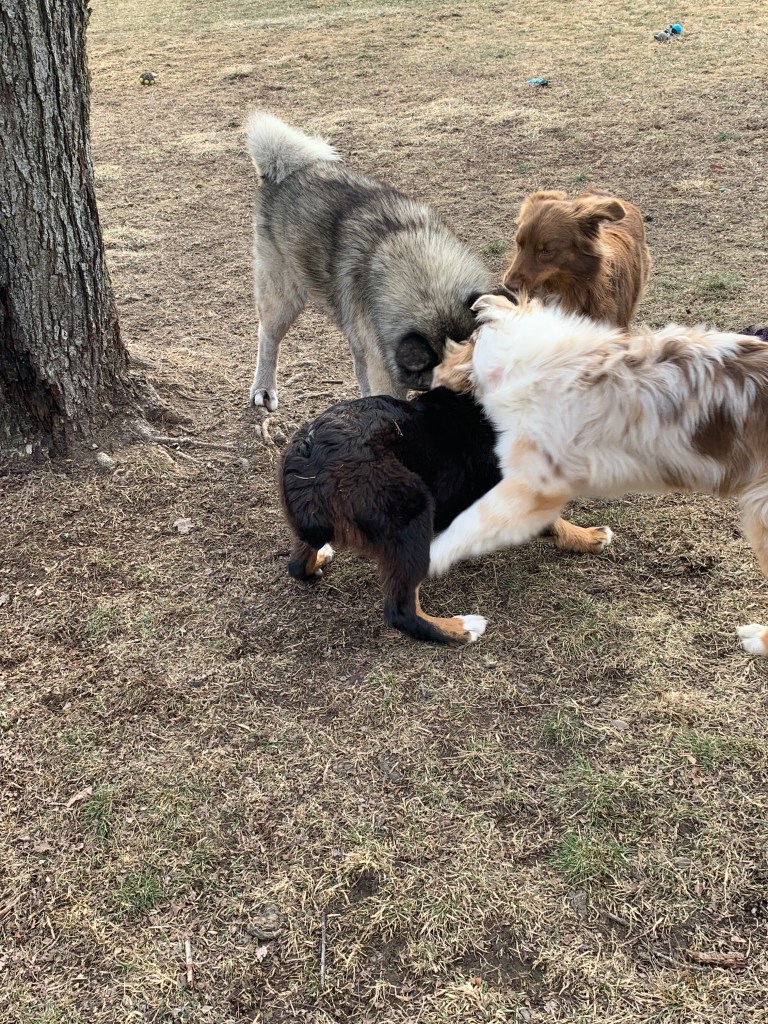
Cedar and Nyssa playing
Nyssa rules the roost here. Yes, she is the biggest, but size doesn’t seem to matter very much to Dash, nor to Cedar. Both of them love her to bits and bask in her attention when she gives it to them. She instructed Dash to play the way she wanted him to from day one, even though he is fifty pounds lighter than her. He happily complied and they play beautifully together to this day.
Cedar, on the other hand, is a cheeky, fresh young lad. Nyssa is thrilled she finally has an Aussie that loves her and plays with her (my previous boy, Tristan, tolerated her presence) but she is always suggesting he take a different approach.
Sometimes Cedar takes that advice, sometimes he doesn’t. But they still end up playing and happy nonetheless.
The key takeaway from this exchange is the suggesting.
As editors, we are asked to look at someone else’s work with the idea of helping them improve it. In that light, our feedback takes the form of suggestions.
We don’t have the final say over what is left in, how it is phrased, or even punctuated sometimes.
Which is OK and we have to BE OK with that.
Suggestions leave room for acceptance, further thought, or rejection. (This may not apply as much to copyediting, which does adhere often to style guides and other rules for the finer elements of writing.)
The point is that our outside view to the work gives us the ability to see other layers that could be explored or a different direction to approach an issue from. To encourage more thought on the matter that could benefit the reader down the line.
Suggestions don’t demand a certain outcome. It’s not in their nature.
Even when Nyssa is “suggesting” to Cedar not to do as he is, he still has the option to continue and most times he does. Then when he does accept her offer of an alternate way, they end up playing together far longer than if he’d ignored her suggestion.
We want to feel that our efforts have been worthwhile over the course of a developmental or line edit—it’s a lot of work! And often that is only judged by how many edits are accepted. Does that mean we have failed?
No. In the end, the final decision is not ours. Authors can be attached to a particular phraseology that sets an editor’s teeth on edge, it’s their prerogative. It’s their creation. And all of us writer-editors will certainly reserve that right in our own stead!
It can be very difficult to separate the emotion of the hard work from the feeling of not being heeded. Good communication between the editor and author can ease this disparity, as can remembering that we are using our expertise to suggest.
Editors still have all of those accepted suggestions that were acknowledged and appreciated to fall back on. The old saying is that you can’t please one hundred percent of the people one hundred percent of the time. Authors know this too, or they will find it out in reviews for certain. It’s not all or nothing.
At the end of an editing project, I remind myself that these are my suggestions for where I can see some extra thought or reworking is needed. Through my comments and our converstaions, the author can choose to do with those ideas as they will. The more important part is reaching the goal of the editor-author partnership—publishing the best work possible.
Which probably means we may play together again. Like Nyssa and Cedar.
She isn’t daunted when he carries on, because she knows she has done her work in communicating her suggestions. It’s then up to him to take them or not. She advises, he asserts and they meet in the middle to carry on and live together well (thankfully for me). It makes their relationship stronger, and it can with authors and editors, too.
By keeping our minds open, our discussions thought-provoking and considerate, and our common goal in mind, we can measure success in more than ‘accepted vs. rejected.’ It seems to work well for dogs, why shouldn’t we consider it? If it means I can eat, sleep, and play, I’m in. So make your suggestions, try not to be daunted by rejected ones, and keep playing!
Have a great week! Woof woof roooooo! 🐕🦺
Fantasy Authors! Have you heard about ProWritingAid’s upcoming Fantasy Week? No?
Do you love writing fantasy?
Our friends at ProWritingAid have you covered!
ProWritingAid’s first ever Fantasy Writer’s Week will be jam-packed with free events for fantasy authors.
With live sessions from bestselling fantasy writers TJ Klune, Angela J. Ford, David Farland and Stephanie BwaBwa, a world-building workshop, and a complete World Anvil software walkthrough, you don’t want to miss this event!
*Please note this is an afffiliate link, so I may receive some compensation if you click through here 😉.
Interested in more information about Red Leaf Word Services editing? Please visit my website www.redleafwords.com. It has undergone some reorganization, come on by and check it out!
There is a new service—The First 100 Pages edit. It’s great for getting an idea of how your story works from the beginning so you can continue with a blueprint in mind, or for giving self-editing a start. Even for trying out a new level of editing. You can find more information about it on the For Fiction Authors page at Red Leaf Word Services.
While you are there, you can sign up for the newsletter, where you can get more of Nyssa. ‘Cause she always has more to say, she’s an Akita! Or you can sign up below 👇🏼 and still get the same editing news, offers, and tips.
Nyssa reveling in the one patch of snow on our walk
Akitas are snow dogs. They wait not-so patiently all year for the white stuff to fly and they revel in it. Unfortunately for Nyssa, our backyard is one of the first places that melts off, even more so with all of the traffic of four dogs. At that point, she has to content herself with rolling in a few patches that remain in the shady areas along our walks. Like in the shot above, she rolls around and creates her own doggy snow angel, savoring every moment she can.
She takes advantage of the snow when it is there.
Which only serves to remind me that I should do the same.
Several times recently I have missed an opportunity that I was interested in, purely because I didn’t act then and there. Of course, there is no way to know whether I would have been selected, but if I don’t apply, then there is no chance, right?
So what holds me back?
Imposter syndrome, mostly, which translates simply to FEAR.
Imposter syndrome is brutal. Once it has insinuated itself into your mind, it is content to hang out and just comment when you think you’ve built up enough confidence to resist it.
All it takes is one little mental sneer, and I’m scrolling onto something else. The demon wins again.
I want nothing more than to beat the bugger into submission once and for all because giving in is not like me. I have enough confidence in every other area of my life, but not this one, not yet. The struggles of new freelancers are real and tough, but everyone has to start somewhere. Why am I having so much trouble kicking this?
Nyssa takes the opportunity to apply herself to what she loves every time she gets it. So in that way, she continually boosts her confidence.
Then she makes snow angels on the ice and wishes for a snowstorm. (Trust me, I know this).
And guess what happens?
It snows. More confidence fills her well.
I need to be more like Nyssa and take the opportunities when they are there. Even if it doesn’t pan out, I still have learned, I have more experience than before, and even a bit more confidence in my well.
So that’s my mission—be more like my dog. Which is definitely not a bad way to be.😄
Do you take advantage of opportunity when it presents itself? Let me know in the comments 👇🏼👇🏼👇🏼
Have a great week! Woof woof roooooo! 🐕🦺
Nyssa is an integral part of Quill & Orb Press editing, where she supervises from the couch. If you are curious about my editing services and the genres I work in, please follow the link to the webpage or you can contact me at aime@redleafwords.com.
My editing is, first and foremost, a collaboration with you that cultivates drafts and ideas into books of gold. 🔮✨✏📚
Want to keep up with Quill & Orb Press behind the scenes? You can subscribe to my newsletter here for service updates, news, projects, and sometimes more of Nyssa. Let’s keep in touch!
Nyssa and her pack howling together, well, except for Wicket.
As they have gotten more comfortable with each other, the dogs have started howling together. It tends to happen when they are all playing and excited in close proximity to one another. Usually Cedar and Wicket are trying to get Dash to run so they can chase him, and Nyssa takes over, as you see and hear above.
They seem to enjoy it, and honestly, I do too. Most times I participate as well. 😄
This communication has brought them closer as a pack and they seem happy to have me in on the event. Good communication often has that effect.
The editor-author relationship is built on communication, in addition to respect and trust. Communication is also the vehicle by which the other two elements are fostered.
Sending your work off to an editor is a huge step. Hopefully it is also one that will contribute to your growth as an author and writer. Most writers have ideas of where their work may be a bit weak, or need some tweaking or building-up. Letting your editor know these areas ahead of time can help them focus on where to direct their attention.
It also lets them know what you perceive as some of your strengths or weaknesses as an author. And how they can best assist you in making your manuscript the best it can be.
Of course there is always the moment when the editorial letter and edited manuscript arrive back in your inbox. Remember your editor is likely nervous too, sending their carefully crafted letter back to you.
When the objective of all parties involved is the same, we have a better chance of understanding each other and having meaningful discussions. We speak the same language about the manuscript in the interest of improving it. We work together, and in the process, strengthen our editor-author relationship.
Just like Nyssa’s pack. Howling together for a stronger bond.
Have a great week! Woof woof roooooo! 🐕🦺
If you would like more information about Quill & Orb Press’s editing services, please visit the website.
“At Quill & Orb Press, collaboration cultivates drafts and ideas into gold.”🔮✨✏📚
Sign up for the Quill & Orb Press newsletter for more of Nyssa and her buddies, service updates and availability, and sundries from the worlds of books and editing. Once a month, direct to you!
Two and a half months have passed since Cedar and Wicket came into our lives. From watching all of their interactions, I would say that collectively they are all now a family pack. Both puppies have fit into the routines and daily flow of the household.
It did take Nyssa and Dash some time to accept the two young ones, though. And I expected that. However, her manner for accepting them was very different. Cedar kind of forced his way down her throat by throwing himself in front of her constantly and kissing her whenever he could. She gets annoyed and he flops in front of her submissively and they play.
It took Nyssa a long time, until last week or so, to give any individual attention to Wicket, though. I was starting to get nervous even, but then she gave him her “nibble treatment” for a while and they played tug and all has been well since. I guess she figured Wicket isn’t going anywhere, and he is sweet and fun, so why not. Dash already plays with him, she may as well, too.
Her decision to accept and integrate, and this time of year when many association memberships come due put me in mind of the benefits of these organizations.
I’ve seen several queries on social media channels about whether the professional editors associations are worth joining. What are the benefits? Is the cost justifiable?
In my opinion, yes, they are.
I am a member of the Editorial Freelancers Association (EFA) and several others. Last year I took a full complement of editing courses from the EFA at discounted rates, which balanced the membership fee. Not to mention those courses were all taught by EFA members who are highly respected editors themselves. I enjoyed every one of them and was grateful for the connections I made with experienced editors. Their feedback was insightful, instructive, and helped me be more confident in my work. I highly recommend the EFA courses if you want editing instruction.
The communities these associations give you the opportunity to be a part of is also a huge resource. Most of them have Facebook groups, both public and private, and the amount of information shared in these forums is astounding. Peer-driven support can be so important for this industry, given that so many of us are working from home, much of the time in solitude. Having a group at the ready to answer questions and bounce sticky bits off of is invaluable. I’ve learned a metric ton just by lurking and following along!
For new editors like myself, it also gives us the space to integrate slowly, to get up to speed at a pace we are comfortable with. Introverts, (like me), certainly appreciate this.
Once again, Nyssa is right. Might as well join and have fun (and learn), than resist and be left without support when it may highly benefit you. If you can join some associations, I say do it. Be part of the community. #editorsjustwannahelp
Have a great week! Woof woof roooooo! 🐕🦺
Want to know more about Quill & Orb Press editing?
I see this topic come up in conversation in online writing groups constantly. This Writer Unboxed episode provides a solid idea of what to expect from an editor and why we aren’t to be feared. Editors have a genuine desire to help authors improve their craft and see their creativity shine. Many of us are writers too, we understand the discomfort involved, and trust me, we don’t want to perpetuate it in someone else! ~
Letting other people—even those close to you—read your novel for the first time can be stressful. You’ll wonder if they’re going to judge you, if they’ll recognize themselves in there, or if you really want your mother to know that you know about these things. But after the first few times, you get used to…
One difference I would note is that where Mr. Dempsey talks about the notations and comments made in “…copy editing and proof reading” stages, at Quill & Orb Press those notations would be part of my line editing and copy editing services.
If you would like to learn more about Quill & Orb Press editing, please visit me here. Enjoy your day!~



 The Sun, a Book, and a Dog