Blog Takeover! Help, I’ve Been Hijacked by The Conflict Thesaurus!

Heads up, Writers! The Conflict Thesaurus Is Here!

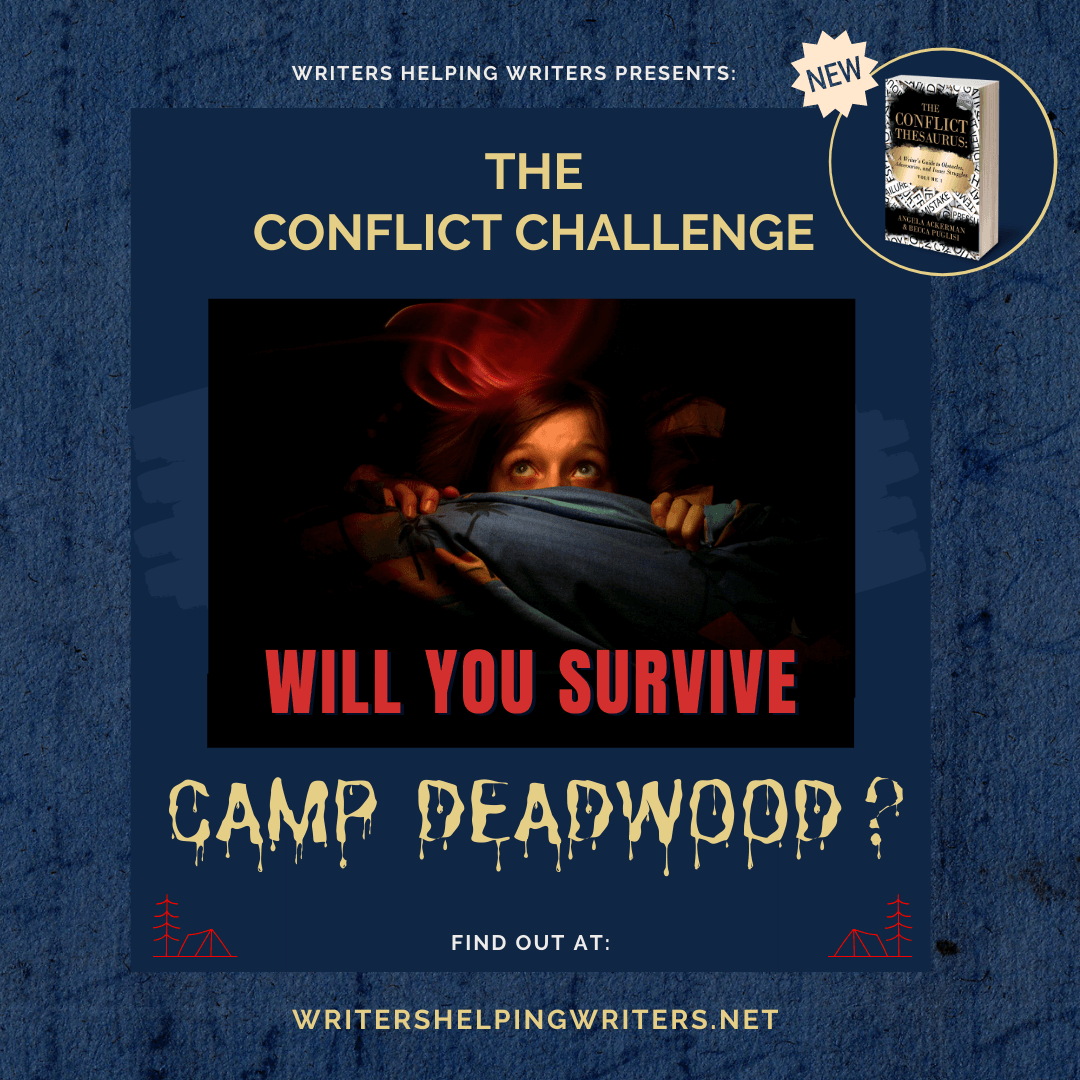
Writers, Can You Survive Danger & Death in the Conflict Challenge?

I don’t know about you, but I get a little excited when a new writing guide comes along. Today I get to spill the news that The Conflict Thesaurus: A Writer’s Guide to Obstacles, Adversaries, and Inner Struggles (Vol. 1) has hit the shelves.

This guide is about that killer ingredient our stories need: Conflict. It shows you exactly how to use conflict to raise tension, create a fresh story premise, and pull readers in. The guide also dives into over 100 conflict scenarios and how each can be endlessly adapted to challenge a character inside and out. Problems, Moral Dilemmas, Ticking Clocks, Obstacles, No-Win Scenarios…this book is plot brainstorming in overdrive!

I’m part of Angela & Becca’s Street Team for this release, and we have an important question to ask you:

Can You Survive Danger as Well as Your Favorite Protagonist?

Sure, it’s easy for you to use conflict to torture your characters and make them struggle, but what if it’s you in the hot seat instead? Will you make good decisions, or bad ones?

It’s time to find out by taking the Conflict Challenge! I dare you to become the protagonist in a special story Angela & Becca have created. And heads up, if you survive, you win some pretty cool stuff!

GIVEAWAY ALERT!

While you’re at Writers Helping Writers taking the Conflict Challenge, make sure to enter The Conflict Thesaurus celebratory giveaway, too. But hurry – it’s only on for a few days.

So, take the challenge…if you dare. And don’t forget to come back and let me know how you did against Camp Deadwood!

If you’d like to find out more about how The Conflict Thesaurus can help your character construction and story, these spectacular writers have put together some posts about conflict and its importance. Check them out with these links:

You can find links to purchase The Conflict Thesaurus and any of the other Writers Helping Writers thesauruses here: https://writershelpingwriters.net/bookstore/ . Get yours TODAY! Your characters will thank you!

See you soon!

ISWG September blog post — How Do You Define Success as a Writer?

Purpose: To share and encourage. Writers can express doubts and concerns without fear of appearing foolish or weak. Those who have been through the fire can offer assistance and guidance. It’s a safe haven for insecure writers of all kinds!
Posting: The first Wednesday of every month is officially Insecure Writer’s Support Group day. Post your thoughts on your own blog. Talk about your doubts and the fears you have conquered. Discuss your struggles and triumphs. Offer a word of encouragement for others who are struggling. Visit others in the group and connect with your fellow writer – aim for a dozen new people each time – and return comments. This group is all about connecting!

 Our Twitter handle is @TheIWSG and hashtag is #IWSG.   

 You ready?
Let’s rock the neurotic writing world!

September 1 question – How do you define success as a writer? Is it holding your book in your hand? Having a short story published? Making a certain amount of income from your writing?

The awesome co-hosts for the September 1 posting of the IWSG are Rebecca Douglass, T. Powell Coltrin @Journaling Woman, Natalie Aguirre, Karen Lynn, and C. Lee McKenzie!


*Image by Peggy und Marco Lachmann-Anke from Pixabay 

At this time in my life, my writing is a sideline venture; one I pursue because I want to. I’m not expecting it to float me financially, at any point, and any monetary gain I might make from it is a bonus—another revenue stream.

And because the time I have to write is sporadic. Building and running my freelance editing business is my main focus, as it should be. But writing my own book dovetails nicely with it.

I often think about this topic after I have finished reading or listening to a book. I do review books on Goodreads, Amazon, NetGalley, and occasionally here, which requires an evaluation of sorts. The first question I ask myself is: Was I entertained by this book?

Rarely do I answer no, because I wouldn’t have gotten that far if I didn’t find it entertaining. For me, then, that author was successful. They entertained me with their story and writing, fulfilling one of the most basic tenets of storytelling.

*Image by Peggy und Marco Lachmann-Anke from Pixabay 

Books are my go-to time fill. I like my reading or audiobooks to take me to places and times I can’t go to on this physical plane. Or for non-fiction, to leave me with a lasting nugget of information I take and use to improve my life or career.

Success for me is about making an impression that lasts. Whether it is with my gardens and plants, my editing, or my writing, I will feel successful if I make an impression on others that lasts. If my clients contact me again when they need an edit, or a reader recalls the blog post about the alternate land of Huphaea at a future date when my book is out, I will have been successful.

©2021 Red Leaf Word Services. All Rights Reserved.

Character Discussions — 8 Steps to Side Characters by Sacha Black & “The Walking Stick” by Donald Maass @Writer Unboxed

Hard on the heels of finishing Sacha Black’s newest masterpiece 8 Steps To Side Characters, this article, “The Walking Stick” , appeared in my inbox. Sacha’s book left my mind reeling, digesting much of what I knew stated in a different way that added clarification and inspiration. Then I read Mr. Maass’s no-punches-pulled airing on the idea of ‘authentic’ characters and what authenticity really means.

Yep, mind-blown. 🤯

To keep your characters from falling flat, starting flat, or feeling flat, I highly recommend these two resources. Happy writing!~

Solid side character instruction with a slathering of singularly-Sacha humor. I recommend it highly!

The Walking Stick

August 4, 2021 By Donald Maass Leave a Comment

There’s a concept in storytelling that I’ve long tried to understand: “authentic”.  Mostly it’s invoked with respect to characters.  It’s important to know them.  It’s important that they act and speak in ways consistent with who they are, whether entering a room or rocketing to the stars.  It’s also important to know how they came to be who they are.  Back story wounds and burdens shape and define them and become the engines of change.

If writing is “authentic” then every gesture, action and utterance is “honest” and everything observed is rendered in a way both original and pinpoint accurate. “Authentic” means writing not to formula but as characters would actually behave, whatever the circumstances.  “Authentic” means they go about their business in their own ways, not the author’s.  Even when they are inspired by real people or reflect the author’s own experience, if characters are “authentic” then a story will always have internal logic and integrity.

It’s something like that.

What bothers me is, how does knowing characters and honoring their independent existence help you to write a story?  I mean, it’s nice if characters behave in ways that are lifelike—or which at least conforms to our understandings of them—then, so far, they can only display who they are.  A backstory-induced need is a good thing and can propel a character toward some sort of emotional resolution, but by doing what?  On top of that, when characters are strongly defined and consistent how can they surprise us? read more…

Reblog — Can Writers Still Be Readers? — Writer Unboxed

This is a topic that comes up often in conversation among writers, and more importantly, among editors. Many who say they do all three activities grouse about how one has ruined some of the others for them. Perhaps I’m in a minority, but I haven’t had this happen. Yet.

It may be that my brain works in a different way, one that segments and separates easier than someone else. I have high Input, Strategic, and Learner Gallup Strengths, information intake is my specialty. It stands to reason that sorting it would be also. I can file away that poignant metaphor or plot twist for later musing and not let it dampen the story or ruin it.

Either way, I find it a fascinating topic that is as individual as the person expressing it. Here’s another opinion from Writer Unboxed.

What do you think? Does writing and/or editing affect your reading?~

image by Paul Bence

All writers begin as readers, right? We fell in love with other people’s stories—where they could take us, what they could do—and then, one day, decided to make a story ourselves. 546 more words

Can Writers Still Be Readers? — Writer Unboxed

Insecure Writers Support Group July Post

The first Wednesday of every month is officially Insecure Writer’s Support Group day. Post your thoughts on your own blog. Talk about your doubts and the fears you have conquered. Discuss your struggles and triumphs. Offer a word of encouragement for others who are struggling. Visit others in the group and connect with your fellow writer – aim for a dozen new people each time – and return comments. This group is all about connecting!

Let’s rock the neurotic writing world!

Our Twitter handle is @TheIWSG and hashtag is #IWSG.

July’s question is: What would make you quit writing?


I can answer this in one word:

Image by OpenClipart-Vectors from Pixabay 

TIME.

Writing has become part of the package of the life I’ve built, but it isn’t what sustains or supports me. It is something I want to do and that I have recently found satisfaction in.

I’ve always known I needed a creative outlet, but it was an aspect that I ignored or boxed up to be let out ‘later’. I was far too busy for writing, I didn’t feel I had anything to write, and I preferred to read in my free time.

I also had landscape designing as my creative outlet. A few birds with one stone there, so to speak.

Since garden design is at a minimum now, I have searched for other ways to be creative. I can’t draw, I’m not musically inclined in the slightest, and poetry is ok, but I’m not often inspired in that manner.

Once I decided to write my own novel and stories, it has all come down to TIME.

It is a huge challenge to get in words when I can, in between gardening, living with three active dogs, house stuff, farm activities, and last but not least, starting and managing an editing business. So far, I get them in when I can, and I’m happy with that.

What tends to happen is if I get ‘into story’ then I stay there until that piece is written and let other things lag, like my blog.

Because I can only do so much.

Image by Pete Linforth from Pixabay 

I’m putting my faith in the tortoise of the proverb, content that ‘slow and steady’ will get the book, story, alternate world written. When the muse whips me along, I go with it as much as I can.

Writing is the thing that I can put aside and pick up later, and it uses more energy than reading, so it takes some preparation during the day. Time is certainly the deciding factor.

If I write, it’s because I have the muse and the time. If I don’t write, it’s because I don’t have the time.

And now that I’ve started, if I stop, it will most certainly be a matter of something else requiring that time.~

Image by Gerd Altmann from Pixabay 

Reblog — Thinking Fiction: The Book as an Object — An American Editor

This topic caught my eye while I was scrolling. I enjoyed the discussion about the phases a manuscript goes through as it passes to different people on the publishing journey. We all believe our writing to be a part of us, but isn’t the idea that it becomes “real” only once someone else has read it a bit ironic? The section about the author-editor relationship and how an editor views a book is informative—something to be kept in mind when you send your work out. Well worth reading for writers and editors, enjoy!~

Carolyn Haley Writing a novel has often been likened to having a baby. The analogy is apt, in terms of gestation, obsession, pain, thrill, frustration, and all that goes with the long-term development of a new life. Less often discussed is what happens later in the process, when it’s time to push the fledgling out […]

Thinking Fiction: The Book as an Object — An American Editor

Nyssa’s Nuggets

“Start the day with something you love.”

Nyssa has two favorite times of the day—walk times and feeding times, both of which occur twice daily. Isn’t she lucky?

Since she was old enough, I have taken her for a walk first thing in the morning. Many people say it helps a dog merge into the day easier if they go out to “patrol” their surroundings first. It seems to work fairly well in the 25 years I have been doing it with seven different dogs.

We speed-walk three-quarters of a mile down the street because she can’t wait to get to the furthest point away from the house that I will go. Then we amble back, or rather I tow her back. She truly loves her walks, no matter when they happen.

When we return, she has her food and then settles in to perhaps play a little, but certainly nap the morning away. All is good.

I find the early morning walks energizing as well. It helps to set the tone of the day, or bring to my attention what my tone is so I can correct it, if need be. It gets my muscles moving and my brain working. I rarely have any sleep fog lingering after the first couple of minutes down the road.

It also gives me the opportunity to witness some truly amazing celestial moments and gorgeous sunrises. Because the traffic gets busy very early around here, we are always walking in the hour or so just before dawn.

The quiet is perfect for a morning mind-sort.

So though at times I rail against morning walks in my mind, (think winter and rain), I do enjoy them.

The open promise of what the day can become is so tangible in those hours before dawn. Starting the day this way has been part of half my life now, so it must be something good.

It gives you more of an opportunity to enter the editing day with a sunny outlook.

Or if you write, getting your own words down first can make the difference between finishing your book and not. You are, after all, your number one customer, right?

Put yourself first and do something that makes you feel good before sitting down to better someone else’s work. Mindset is everything.

Do you start the day with something that makes you feel good, feel strong, feel positive? Try a walk one warm morning, and I guarantee you will feel uplifted the moment the birds start singing while the sky changes color in burgeoning silence. Or get that next paragraph written, or master that yoga stretch. A few little endorphins patrolling around your brain and you will be ready to take on that block of text you gave up on last night.

Shake off the sleep, wake the muscles, drop off the dregs of yesterday, and walk home with a spring in your step and your tail curled high on your back. Like Nyssa does. Akitas do know best.

Have a great week! Woof woof roooooo!~ 🐕‍🦺


What is your morning routine, does it start with something that makes you feel good? If not, would you like it to? Let me know in the comments below 👇🏼, maybe we can help each other better our mornings.😊

If you’d like to get more editing tips for your own editing endeavors, subscribe to the Red Leaf Word Services newsletter and get your copy of my 15 Tips for Self-Editing checklist.

You can find the checklist popup at www.redleafwords.com, or use this link here to sign up and get your copy! You may even get more of Nyssa in the newsletter too 😉.

©2021 Red Leaf Word Services. All Rights Reserved.

Reblog — 11 Techniques for Transforming Clichéd Phrasings — WRITERS HELPING WRITERS®

One of the editing tips I recently posted on my social media channels for Red Leaf Words Services had to do with rephrasing clichés in your own unique way when you want to use the basic idea. This post from the informative ladies at Writers Helping Writers shows you how to do just that. Your readers will thank you!~

One of the things that pumps me up the most when I’m reading a book is when the author phrases things in a way I’ve never seen before. It could be a familiar concept or image—red hair, an urban street, fear—but when it’s written differently, I’m able to visualize that thing in a new way,…

11 Techniques for Transforming Clichéd Phrasings — WRITERS HELPING WRITERS®

Nyssa’s Nuggets

“I’m suggesting you take a different approach, Cedar.”

Cedar and Nyssa playing

Nyssa rules the roost here. Yes, she is the biggest, but size doesn’t seem to matter very much to Dash, nor to Cedar. Both of them love her to bits and bask in her attention when she gives it to them. She instructed Dash to play the way she wanted him to from day one, even though he is fifty pounds lighter than her. He happily complied and they play beautifully together to this day.

Cedar, on the other hand, is a cheeky, fresh young lad. Nyssa is thrilled she finally has an Aussie that loves her and plays with her (my previous boy, Tristan, tolerated her presence) but she is always suggesting he take a different approach.

Sometimes Cedar takes that advice, sometimes he doesn’t. But they still end up playing and happy nonetheless.

The key takeaway from this exchange is the suggesting.

As editors, we are asked to look at someone else’s work with the idea of helping them improve it. In that light, our feedback takes the form of suggestions.

We don’t have the final say over what is left in, how it is phrased, or even punctuated sometimes.

Which is OK and we have to BE OK with that.

Suggestions leave room for acceptance, further thought, or rejection. (This may not apply as much to copyediting, which does adhere often to style guides and other rules for the finer elements of writing.)

The point is that our outside view to the work gives us the ability to see other layers that could be explored or a different direction to approach an issue from. To encourage more thought on the matter that could benefit the reader down the line.

Suggestions don’t demand a certain outcome. It’s not in their nature.

Even when Nyssa is “suggesting” to Cedar not to do as he is, he still has the option to continue and most times he does. Then when he does accept her offer of an alternate way, they end up playing together far longer than if he’d ignored her suggestion.

We want to feel that our efforts have been worthwhile over the course of a developmental or line edit—it’s a lot of work! And often that is only judged by how many edits are accepted. Does that mean we have failed?

No. In the end, the final decision is not ours. Authors can be attached to a particular phraseology that sets an editor’s teeth on edge, it’s their prerogative. It’s their creation. And all of us writer-editors will certainly reserve that right in our own stead!

It can be very difficult to separate the emotion of the hard work from the feeling of not being heeded. Good communication between the editor and author can ease this disparity, as can remembering that we are using our expertise to suggest.

Editors still have all of those accepted suggestions that were acknowledged and appreciated to fall back on. The old saying is that you can’t please one hundred percent of the people one hundred percent of the time. Authors know this too, or they will find it out in reviews for certain. It’s not all or nothing.

At the end of an editing project, I remind myself that these are my suggestions for where I can see some extra thought or reworking is needed. Through my comments and our converstaions, the author can choose to do with those ideas as they will. The more important part is reaching the goal of the editor-author partnership—publishing the best work possible.

Which probably means we may play together again. Like Nyssa and Cedar.

She isn’t daunted when he carries on, because she knows she has done her work in communicating her suggestions. It’s then up to him to take them or not. She advises, he asserts and they meet in the middle to carry on and live together well (thankfully for me). It makes their relationship stronger, and it can with authors and editors, too.

By keeping our minds open, our discussions thought-provoking and considerate, and our common goal in mind, we can measure success in more than ‘accepted vs. rejected.’ It seems to work well for dogs, why shouldn’t we consider it? If it means I can eat, sleep, and play, I’m in. So make your suggestions, try not to be daunted by rejected ones, and keep playing!

Have a great week! Woof woof roooooo! 🐕‍🦺


Fantasy Authors! Have you heard about ProWritingAid’s upcoming Fantasy Week? No?

Do you love writing fantasy? 

Our friends at ProWritingAid have you covered!

ProWritingAid’s first ever Fantasy Writer’s Week will be jam-packed with free events for fantasy authors.

With live sessions from bestselling fantasy writers TJ Klune, Angela J. Ford, David Farland and Stephanie BwaBwa, a world-building workshop, and a complete World Anvil software walkthrough, you don’t want to miss this event!

Register for this free event here: https://prowritingaid.com/art/1571/fantasy-writer-s-week-at-prowritingaid.aspx?afid=8897

*Please note this is an afffiliate link, so I may receive some compensation if you click through here 😉.

Interested in more information about Red Leaf Word Services editing? Please visit my website www.redleafwords.com. It has undergone some reorganization, come on by and check it out!

There is a new service—The First 100 Pages edit. It’s great for getting an idea of how your story works from the beginning so you can continue with a blueprint in mind, or for giving self-editing a start. Even for trying out a new level of editing. You can find more information about it on the For Fiction Authors page at Red Leaf Word Services.

While you are there, you can sign up for the newsletter, where you can get more of Nyssa. ‘Cause she always has more to say, she’s an Akita! Or you can sign up below 👇🏼 and still get the same editing news, offers, and tips.

[mailerlite_form form_id=2]

©2021 Red Leaf Word Services. All Rights Reserved.

Reblog — Hopes and Fears and Fiction — Writer Unboxed

This landed in my inbox this morning, the day after I wrote a piece about fear. Fear has been on my mind a lot lately and I am in a constant struggle with it in several areas of my life.

In this piece, Donald Maass reminds writers of some questions that should be asked while writing, and then asked again by editors as they make suggestions.

Reading it reminded me of why I read certain things at certain times. Maybe it will resonate with you, too.

And I also just remembered I need to buy his book, The Emotional Craft of Fiction, I’ve been meaning to for a while. Happy Birthday to me! 🎂

What do you need to be reminded of today?

What are your hopes and dreams?  What are you most afraid of? Search online for common fears and phobias, and you will quickly find that whatever terrifies you also terrifies others.  Do you, for instance, suffer (as so many do) from Koumpounophobia, Alektorophobia, Sidonglobophobia, or Hippotomonstrosequippedaliophobia?  Those are the paralyzing fears of buttons, chickens, cotton…

Hopes and Fears and Fiction — Writer Unboxed